Across asset-intensive industries, maintenance has steadily matured. Preventive compliance has improved. Condition monitoring is widespread. Work order governance is structured. Yet despite this progress, many maintenance leaders continue to confront the same frustration: unplanned disruption remains persistent.
The issue is rarely discipline. It is visibility.
Within structured enterprise systems such as Oracle Maintenance Cloud, organizations already capture detailed asset history, work order records, failure codes, and cost data. The opportunity now is not data collection. It is data interpretation.
AI-driven predictive maintenance represents a shift from maintaining assets efficiently to managing reliability strategically.
That shift unfolds across six interconnected dimensions.
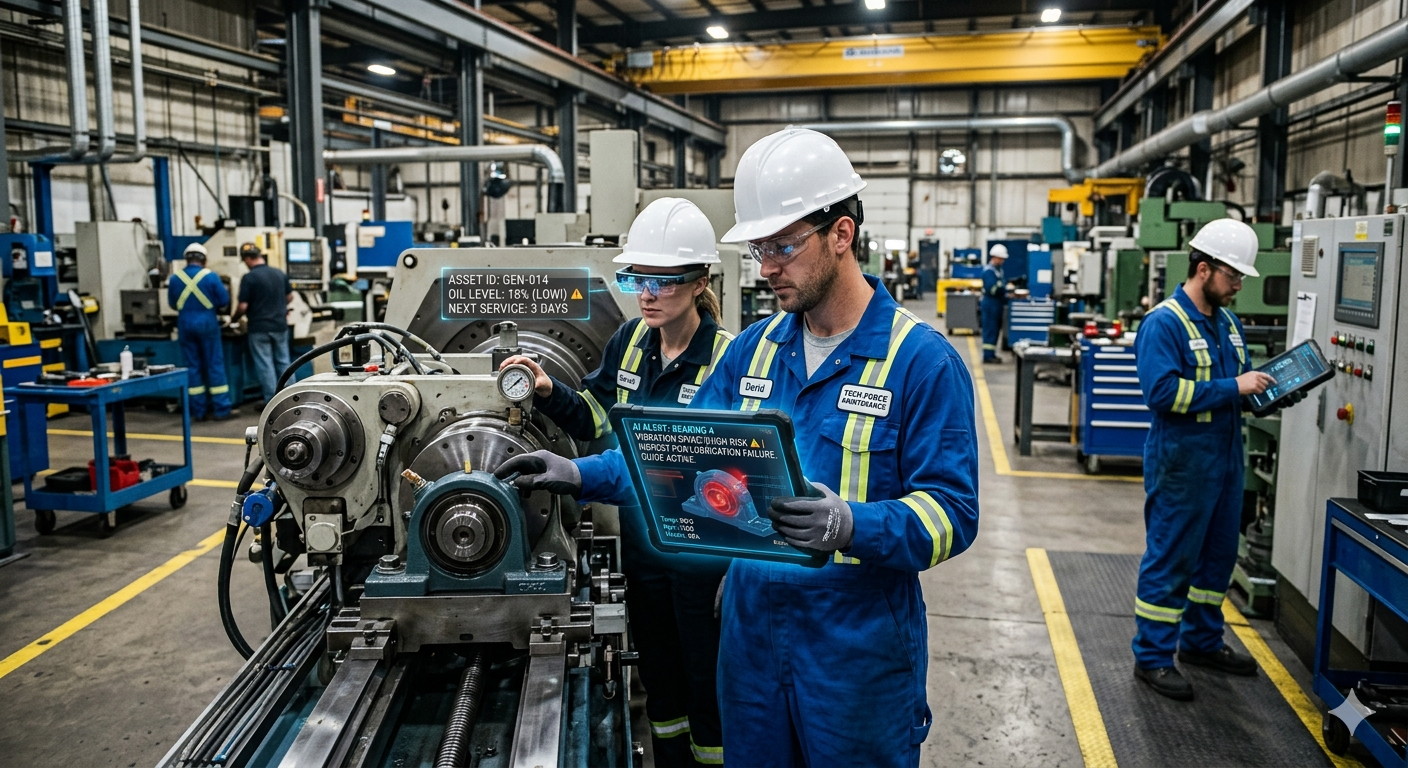
Many organizations operate with condition-based programs that trigger interventions when thresholds are crossed. While effective at preventing catastrophic breakdowns, these models remain fundamentally reactive.
Ai-driven Predictive maintenance introduces probability modeling. Instead of waiting for deviations to breach limits, AI analyzes behavioral trajectories to forecast when instability is likely to occur.
This evolution—from monitoring asset state to modeling asset behavior—forms the foundation of reliability stability. It marks the transition from reaction management to exposure forecasting. To learn more about Predictive vs. Condition-Based Maintenance.
Even with predictive alerts, value is lost if work sequencing remains subjective. Traditional prioritization often reflects urgency rather than quantified risk.
AI-based prioritization introduces dynamic scoring that evaluates probability of failure alongside operational consequences. Within Oracle environments, where asset criticality and history are structured, risk-based sequencing becomes defensible and consistent.
Planning discussions shift from negotiation to exposure management. Backlogs stabilize. Emergency work declines gradually. To learn more about AI-Based Work Order Prioritization in Oracle Maintenance Cloud
Historically, downtime initiatives focused on reducing repair time. Predictive capability reframes the objective: reduce the frequency of failure itself.
By analyzing degradation patterns across years of asset performance, AI identifies instability earlier in the lifecycle. Maintenance interventions align with controlled production windows rather than emergency interruptions.
Downtime reduction becomes systemic rather than episodic.
Most maintenance teams already track KPIs diligently. However, dashboards often function as retrospective scorecards.
Advanced analytics transform KPIs into forward-looking indicators. Instead of simply reporting emergency ratios or schedule compliance, AI surfaces causal relationships and emerging exposure clusters.
Within structured Oracle ecosystems, cross-dimensional analysis connects asset behavior, labor allocation, inventory constraints, and production cycles.
Performance management shifts from explanation to prevention.
Predictive insights create additional planning complexity. Without intelligent scheduling, early detection simply increases planner burden.
Smart scheduling introduces scenario-based optimization that balances asset risk, technician skill alignment, spare parts readiness, and production commitments.
The result is not automation for its own sake, but workforce stability. Labor becomes aligned with risk exposure rather than displaced by reactive demands.
The final and most critical dimension lies in frontline execution.
Predictive models, prioritization logic, and optimized schedules operate at the planning layer. Reliability, however, is built in the field.
Connected worker execution ensures that technicians receive contextualized work orders, capture inspection data in structured formats, and synchronize updates seamlessly—even in low-connectivity environments.
When execution feedback loops remain tight, predictive models strengthen over time. When they fragment, analytical maturity stalls.
Connected execution therefore functions as the integrity layer of predictive strategy.
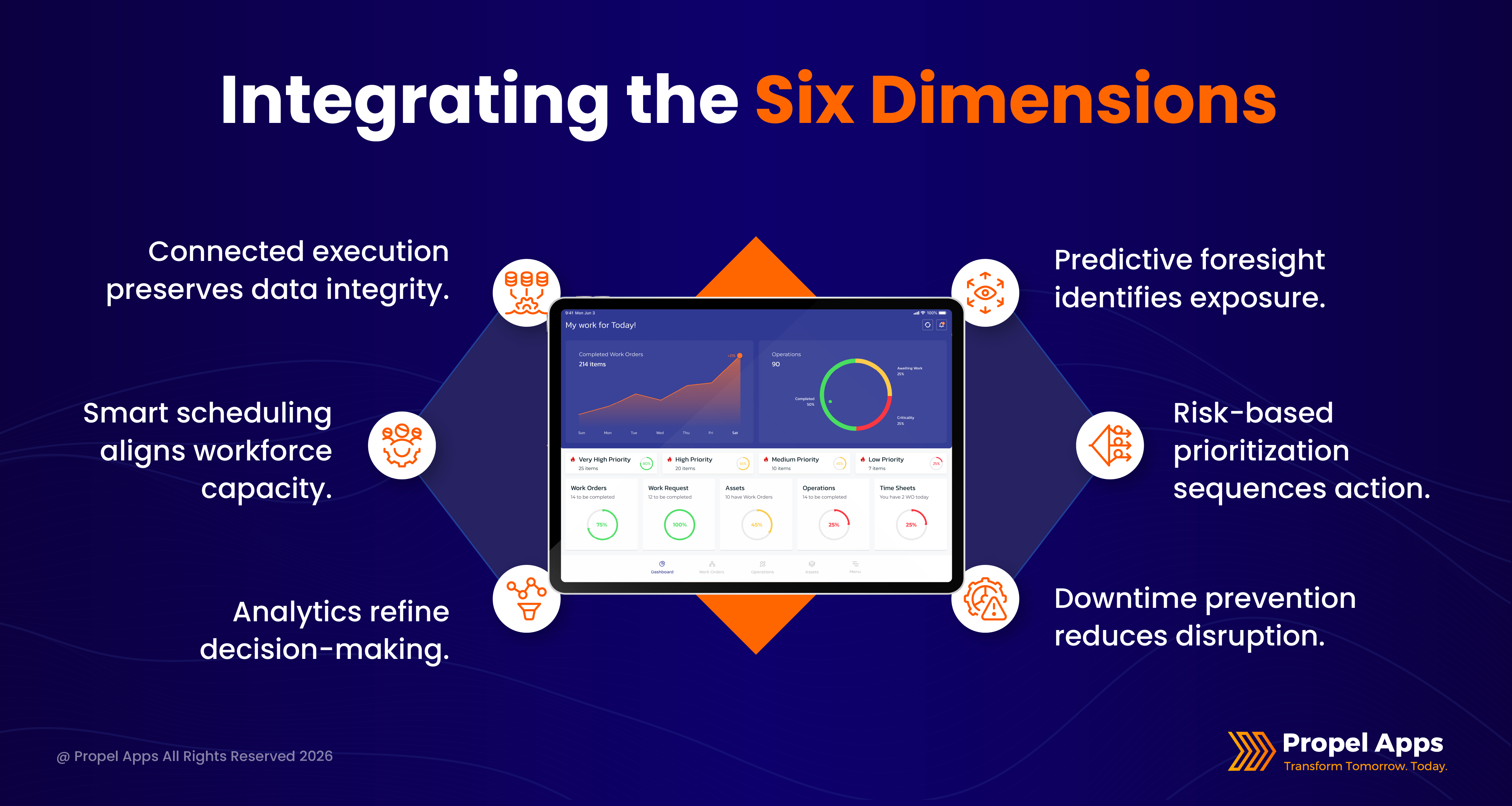
These six dimensions are not independent initiatives. They form a reliability control system:
In Oracle-based maintenance environments, the structural foundation already exists. Asset hierarchies, work order governance, inventory workflows, and compliance controls provide the architecture upon which predictive capability can scale.
The transformation is not achieved through technology deployment alone. It requires operating model alignment—governance discipline, cross-functional coordination, and execution rigor.
For maintenance leaders, AI-driven predictive maintenance is not a modernization trend. It is a response to growing operational complexity.
Aging infrastructure, variable production demand, regulatory pressure, workforce transitions, and cost scrutiny all intensify reliability expectations. Static maintenance frameworks struggle to absorb this variability.
Predictive maturity introduces adaptive control.
The organizations that succeed are not those with the most sensors or the largest analytics teams. They are those that integrate predictive insight, disciplined prioritization, workforce optimization, and connected execution into a coherent reliability strategy.
The outcome is not perfection. It is stability under pressure. And in asset-intensive industries, stability is the true competitive advantage.
Ready to move beyond the clipboard?Transitioning to a digital-first maintenance strategy doesn't have to be complex. We’ve helped global teams digitize their floor operations without disrupting their existing workflows. Our Connected Worker Solution is built for the field and your teams.