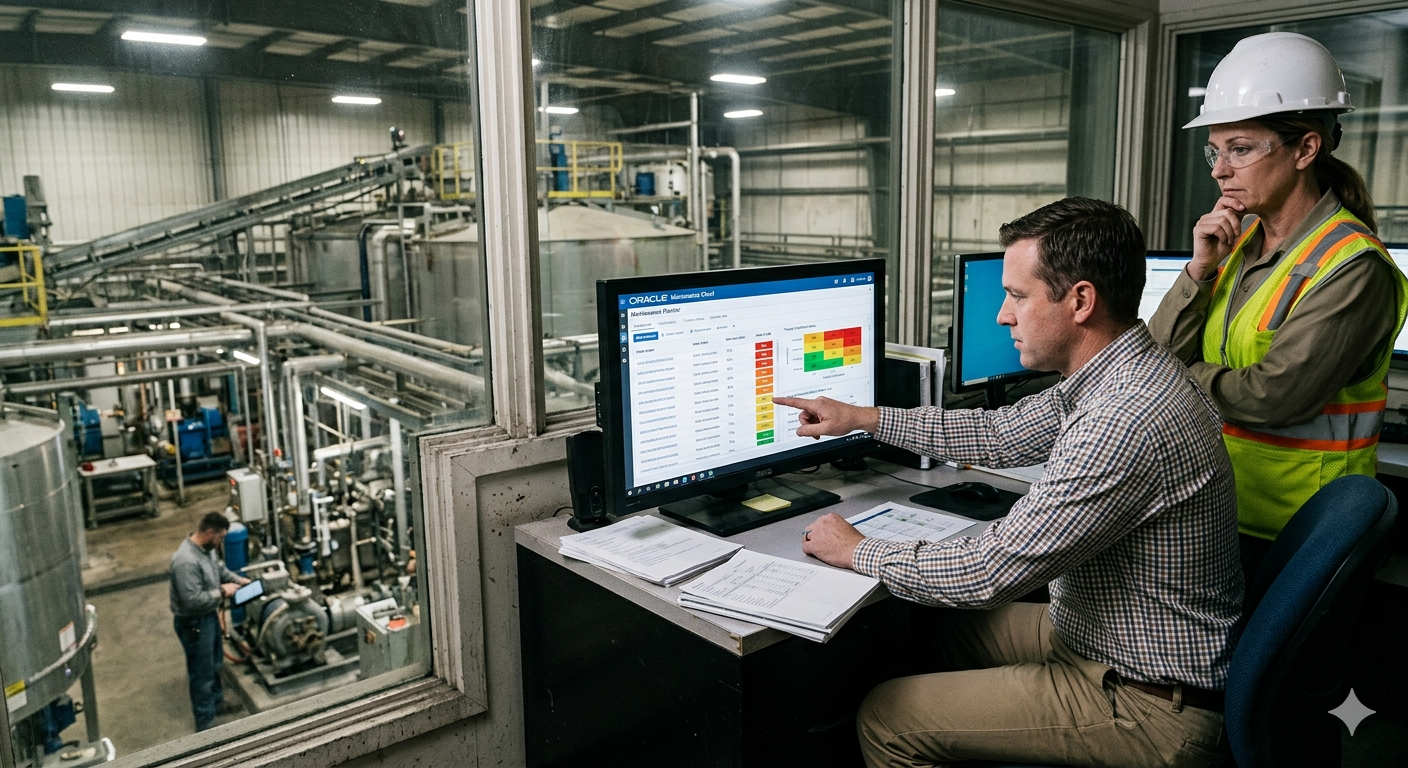
Ask any operations leader where reliability pressure surfaces most visibly, and the answer is almost always the same: unplanned downtime.
It rarely appears in isolation. A critical asset fails. Production schedules shift. Labor is redeployed. Expedited parts are ordered. Financial exposure compounds quickly. Post-incident reviews follow, often thorough and disciplined. Yet months later, a similar disruption occurs elsewhere in the system.
The issue is seldom effort. It is predictability.
In many enterprises operating within structured systems such as Oracle Maintenance Cloud, downtime events are well documented. Failure codes are logged. Repair histories are traceable. Mean time to repair is tracked closely. What remains less stable is the organization’s ability to reduce the frequency of disruption itself.
That distinction separates operational responsiveness from operational resilience.
Over the past two decades, most asset-intensive organizations have strengthened preventive maintenance compliance. Many have implemented condition monitoring. Root cause analysis processes have matured. Spare parts strategies have become more sophisticated.
These improvements matter. They reduce repair duration and improve recovery coordination.
Yet in many environments, unplanned downtime persists at uncomfortable levels.
The reason lies in timing. Condition monitoring typically identifies issues once measurable thresholds are breached. By that stage, degradation is already advanced. The intervention may prevent catastrophic failure, but operational disruption often still occurs.
In effect, organizations become efficient at responding to instability rather than preventing it.
AI changes the economics of downtime reduction by focusing on behavioral trajectories rather than threshold violations.
Instead of reacting to a temperature spike or vibration anomaly after it exceeds tolerance, predictive models analyze multi-year historical patterns across load conditions, environmental variables, usage cycles, and maintenance interventions. Subtle deviations — often invisible in isolated readings — reveal emerging instability.
The shift is not from monitoring to alerting. It is from monitoring to forecasting.
This transition enables planners to schedule corrective action during controlled windows rather than emergency intervals. Production alignment improves. Labor utilization stabilizes. The system absorbs intervention with less disruption.
Over time, the frequency of surprise failures declines.

A common misconception is that downtime reduction is purely a mechanical problem. In reality, it is systemic.
Failure probability may be influenced by:
AI models operating within Oracle-based ecosystems can surface correlations across these dimensions because the data resides within a unified structure. Asset genealogy connects components to parent systems. Work order histories reveal recurring degradation patterns. Inventory records expose supply constraints.
When analyzed collectively, downtime ceases to appear random. It becomes traceable to systemic friction points.
This is where predictive maturity begins.
Advanced analytics cannot compensate for weak data governance. Predictive performance depends heavily on consistent failure classification, accurate closure notes, and disciplined asset master management.
Organizations often discover that their predictive ambitions expose underlying data inconsistencies. This is not a failure of AI. It is a diagnostic benefit.
As governance improves, predictive signals strengthen. Risk scoring becomes more precise. Planning confidence increases.
Downtime reduction is therefore as much about data discipline as it is about modeling sophistication.
Even the most accurate predictive insight loses value if it cannot be translated into timely field action.
Technicians must receive contextualized work orders that include risk indicators and asset history. Inspection findings must synchronize back into the system without delay, even in low-connectivity environments. Supervisors must validate completion data in real time to preserve model integrity.
This is where connected worker platforms play a strategic role. Mobility and offline capability are not conveniences; they are enablers of predictive continuity. When execution friction is minimized, feedback loops tighten, and models learn faster.
Downtime reduction accelerates only when intelligence and execution operate as a closed system.
Short-term success is often measured through reduced repair duration. Long-term success is reflected in declining emergency work ratios and increasing mean time between failures.
The most telling indicator is volatility reduction. When weekly production reviews no longer center on surprise breakdowns, the organization has crossed an inflection point.
The objective is not the elimination of failure. Mechanical systems will always degrade. The objective is the reduction of uncertainty surrounding that degradation.
AI contributes by illuminating risk earlier in the lifecycle. Oracle-based platforms provide the structured environment in which that illumination becomes actionable.
Downtime is frequently discussed as a maintenance metric. In practice, it is an enterprise risk indicator. It reflects how well an organization understands the behavior of its assets under real-world conditions.
AI-driven predictive capability, embedded within structured Oracle environments and supported by disciplined frontline execution, enables a transition from reactive stabilization to proactive orchestration.
The shift is gradual but cumulative. As predictive confidence grows, planning horizons extend. Emergency interventions decline. Operational stability strengthens.
The organizations that succeed are not those that deploy the most sensors. They are those that treat downtime reduction as an operating model evolution — integrating analytics, governance, prioritization, and connected execution into a coherent reliability strategy.