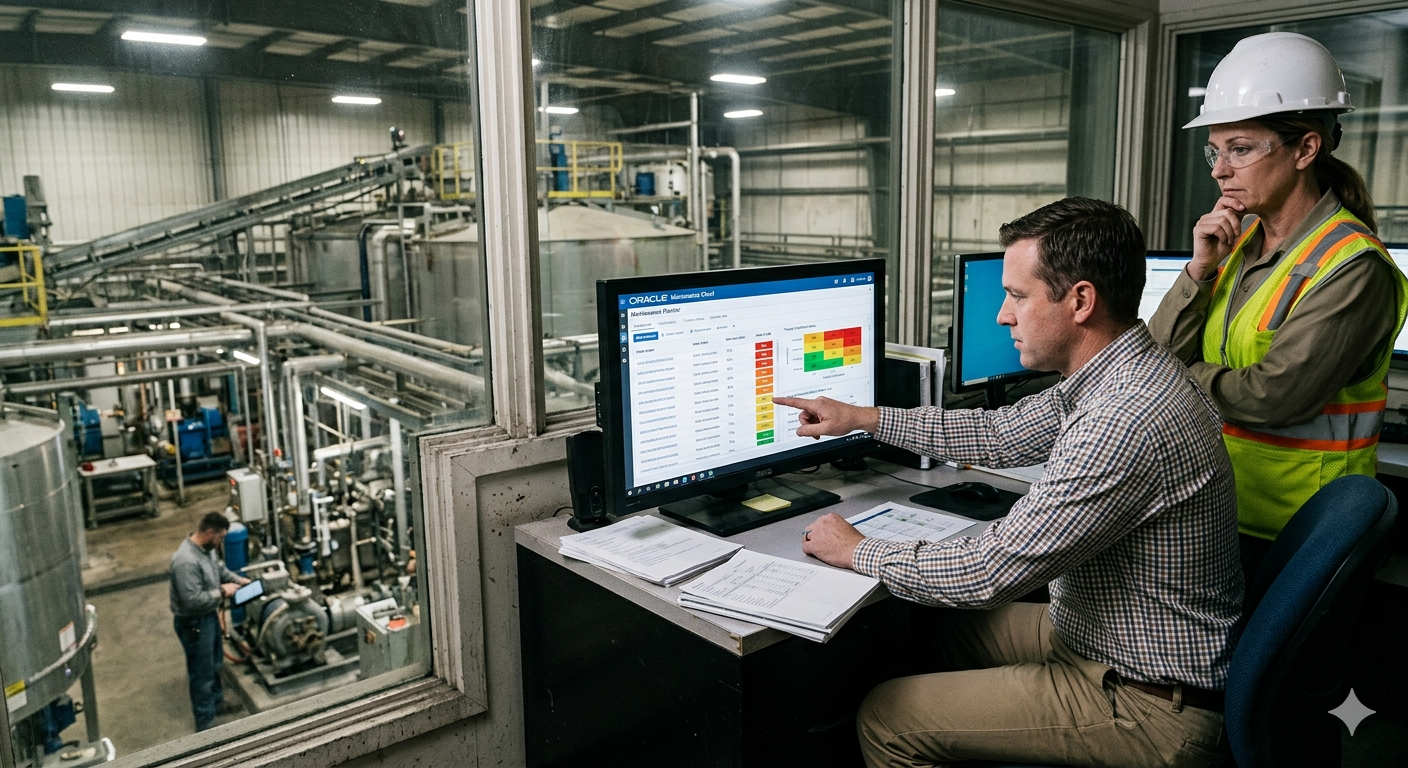
In many maintenance organizations, KPI dashboards are well established. Metrics such as mean time to repair, preventive maintenance compliance, schedule adherence, and backlog volume are tracked monthly, sometimes weekly. Leadership reviews them diligently.
Yet despite consistent reporting, performance often feels reactive.
Breakdowns still disrupt production.
Emergency work fluctuates unpredictably.
Backlogs expand under pressure.
The issue is rarely the absence of metrics. It is the way those metrics are interpreted and operationalized.
Within structured systems such as Oracle Maintenance Cloud, analytics capabilities are robust. The platform captures detailed work order histories, asset hierarchies, cost records, and failure data. The challenge for maintenance leaders is not generating reports. It is translating data into forward-looking performance control.
Traditional KPI review cycles focus on past performance. How many preventive tasks were completed? What was last month’s emergency work ratio? How long did it take to close high-priority work orders?
These indicators are useful for accountability. However, they are lagging by nature. They describe what has already occurred.
When KPIs are treated solely as scorecards, they reinforce compliance discipline but rarely shift reliability outcomes. Maintenance teams may improve metric appearance without fundamentally reducing exposure.
Optimization begins when metrics are reframed as early signals rather than retrospective summaries.

The most maintenance leaders view KPIs not as isolated numbers but as interconnected patterns.
For example, a rise in emergency work percentage may correlate with deferred preventive tasks several weeks earlier. An increase in mean time to repair may reflect spare parts lead-time variability rather than technician capability. Backlog aging trends may signal prioritization inconsistency rather than labor shortage.
AI-enhanced analytics can surface these correlations within Oracle environments by analyzing cross-dimensional data sets — work history, asset condition, production cycles, inventory constraints, and workforce allocation.
The objective is not more dashboards. It is causal visibility.
When leaders understand why metrics shift — not just that they shift — intervention becomes strategic rather than reactive.
Many maintenance programs prioritize compliance rates: preventive maintenance completion percentage, inspection adherence, and scheduled work execution. While essential, these measures alone do not guarantee reduced failure probability.
Exposure metrics provide deeper insight. These may include:
When analytics identify clusters of risk concentration, leaders can intervene before performance degrades visibly.
In Oracle-based ecosystems, where asset genealogy and work order lineage are structured, these exposure views become traceable and defensible.
As predictive maintenance capabilities mature, KPI optimization evolves from descriptive to prescriptive.
Instead of reporting that schedule compliance declined, systems can indicate which upcoming work orders are at risk of delay. Rather than observing that emergency work increased, models can highlight which assets are trending toward instability.
Prescriptive analytics extend this further by recommending optimal sequencing or resource reallocation to minimize risk exposure.
The transition from descriptive to predictive and prescriptive insight marks a critical maturity shift. Maintenance leadership moves from explaining results to shaping them.
Analytics strength depends heavily on execution accuracy. If technicians close work orders with incomplete data, if failure codes are inconsistent, or if inspection results are delayed due to connectivity constraints, analytical reliability weakens.
Connected worker enablement directly influences KPI integrity. Mobile-first execution, structured digital forms, and real-time synchronization ensure that data flowing into Oracle systems reflects actual field conditions.
The feedback loop tightens. Models learn faster. KPI interpretation becomes more precise.
In this sense, analytics optimization is inseparable from execution discipline.
Asset-intensive industries face increasing variability — fluctuating production demand, aging infrastructure, regulatory pressure, and cost constraints. Static KPI frameworks struggle to account for these dynamics.
AI-driven analytics introduce adaptive insight. They adjust risk assessments as conditions change. They highlight emerging failure patterns earlier. They enable maintenance leaders to recalibrate priorities before instability spreads.
The result is not perfection. It is stability.
When performance volatility decreases, leadership confidence increases. Planning horizons extend. Cross-functional trust improves.
KPI optimization is not about expanding reporting volume. It is about aligning measurement with exposure management.
Within Oracle environments, the infrastructure for advanced analytics already exists. The opportunity lies in elevating metrics from retrospective compliance indicators to forward-looking decision tools.
Organizations that succeed treat analytics as a management discipline, not a reporting exercise. They integrate predictive signals, execution feedback, and governance rigor into a coherent performance framework.
Over time, the conversation shifts. Reviews no longer center solely on last month’s numbers. They focus on where risk is building and how to intervene before disruption occurs.
That shift defines analytical maturity.
Maintenance analytics are only as effective as the execution data behind them. Organizations using Oracle Maintenance Cloud need real-time visibility from the field to transform KPI reporting into proactive reliability management.
Propel Apps Connected Worker Platform helps maintenance teams extend Oracle workflows directly to frontline operations through mobile execution, AI-powered digital forms, offline data capture, inspections, work order updates, and real-time synchronization.
By combining connected worker execution with Oracle maintenance analytics, organizations can improve data accuracy, strengthen KPI integrity, reduce operational blind spots, and enable more predictive maintenance decision-making across asset-intensive environments.