Predictive insight has limited value if it cannot be translated into executable schedules.
Many maintenance organizations have made progress in identifying risk earlier. Work orders are prioritized more intelligently. Downtime signals are detected sooner. Analytics highlight exposure clusters. Yet the final bottleneck often remains unchanged: scheduling.
It is one thing to know what should be done.
It is another to determine when, by whom, and with what dependencies.
Within structured platforms such as Oracle Maintenance Cloud, scheduling capabilities are robust. Work definitions, resource assignments, shift calendars, and asset availability windows are all defined. The difficulty lies not in system capability, but in decision complexity.
In many plants, scheduling still relies heavily on planner experience. Senior planners balance labor availability, skill sets, production commitments, spare parts readiness, and safety constraints. They do so under time pressure, often recalibrating daily.
This expertise is valuable. But it does not scale easily.
When predictive alerts increase in volume, or when production demand fluctuates sharply, manual scheduling frameworks struggle to absorb variability. Work is deferred. Preventive tasks are pushed forward. Emergency interventions displace planned activities.
Over time, scheduling instability becomes a driver of downtime itself.
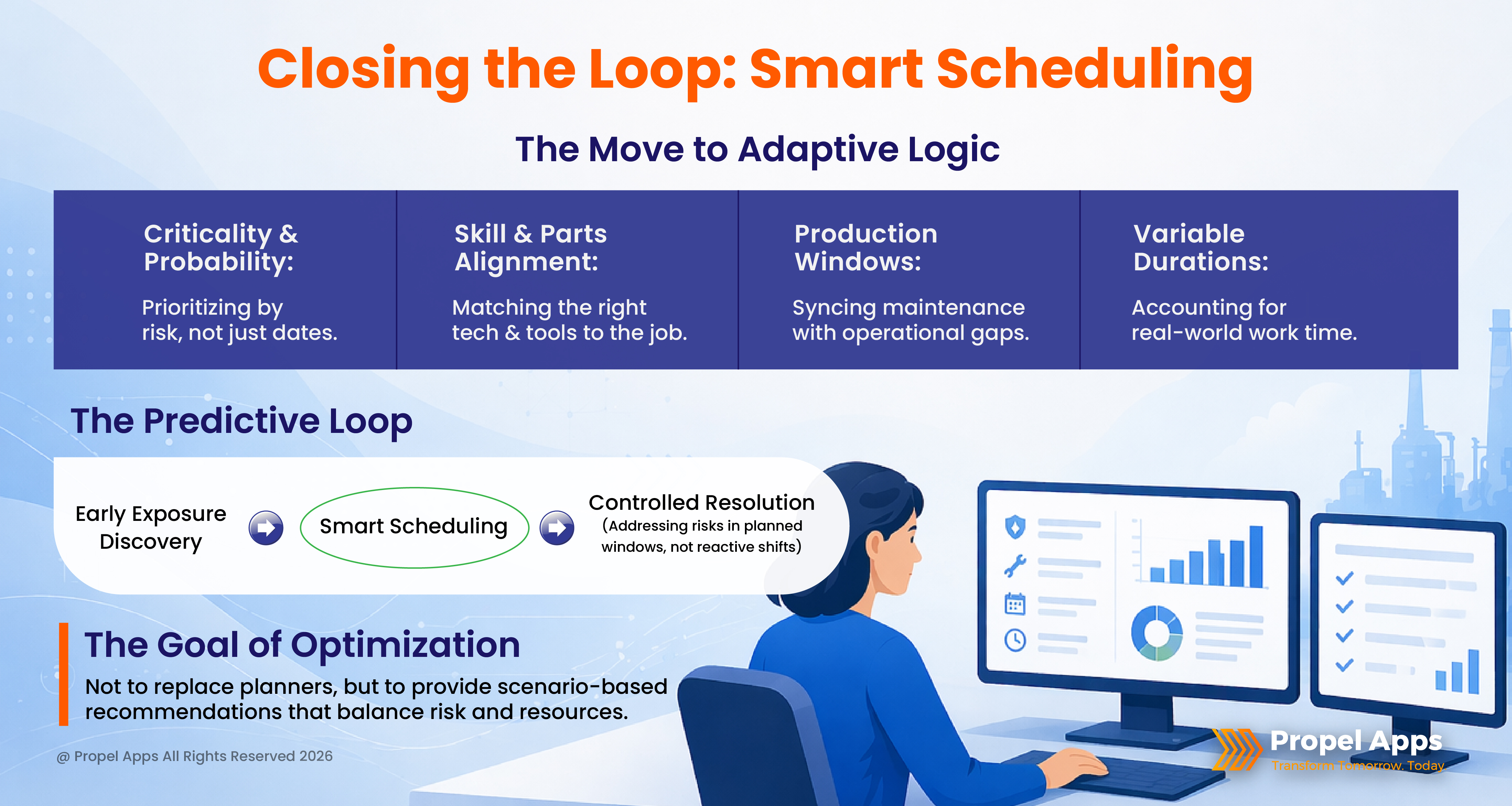
Smart scheduling introduces adaptive logic into workforce allocation. Rather than treating weekly plans as fixed documents, optimization engines evaluate:
The objective is not to automate planners out of the process. It is to provide scenario-based recommendations that balance risk and resource constraints.
When predictive maintenance identifies exposure early, smart scheduling ensures that exposure is addressed within controlled windows rather than through reactive displacement.
The integration of risk insight and workforce planning is what closes the predictive loop.
Maintenance reliability is often discussed in mechanical terms. Yet workforce dynamics play an equally critical role.
Skill gaps, technician fatigue, uneven workload distribution, and overtime reliance can all influence repair quality and response time. AI-enhanced scheduling models can detect patterns such as recurring bottlenecks tied to specific skill categories or time periods.
For maintenance leaders, this visibility reframes workforce planning as a strategic reliability lever rather than a staffing exercise.
Optimization does not simply reduce labor cost. It reduces execution variability.
Oracle-based ecosystems provide a unified environment in which asset data, labor assignments, procurement workflows, and production schedules intersect. This integration is essential for intelligent scheduling.
When predictive alerts surface within the same system that manages resource calendars and material reservations, optimization becomes contextual rather than isolated. Scheduling decisions are informed by real-time availability and structured dependencies.
Without such integration, predictive insight and workforce planning operate in silos, diluting impact.
Even the most optimized schedule loses value if field execution deviates due to data friction. Technicians require mobile access to updated assignments. Changes in asset condition must synchronize rapidly to prevent outdated task sequencing. Work completion must be logged accurately to preserve future scheduling precision.
Connected worker enablement ensures that scheduling logic remains aligned with field reality. Offline capability, structured digital inputs, and real-time synchronization protect data integrity and shorten feedback cycles. Optimization thrives in environments where execution visibility is high.
When predictive intelligence, risk-based prioritization, and smart scheduling converge, maintenance operations begin to exhibit a more stable rhythm.
Emergency interventions decline gradually. Preventive compliance improves without excessive overtime. Planner stress reduces because trade-offs are data-informed rather than purely judgment-driven. Production collaboration strengthens because maintenance commitments become more predictable.
The transformation is not dramatic in a single quarter. It compounds through consistent alignment between insight and execution.
For maintenance leaders, smart scheduling is not about algorithmic sophistication alone. It is about confidence.
Confidence that the right work is being performed at the right time.
Confidence that workforce capacity aligns with risk exposure.
Confidence that predictive signals are not lost in planning bottlenecks.
Within Oracle environments, the structural foundation already exists. AI-driven optimization extends that foundation into adaptive workforce orchestration. The outcome is not perfection. It is disciplined execution under complexity and in asset-intensive industries, disciplined execution is often the difference between stability and recurring disruption.
Smart scheduling depends on accurate execution visibility. Maintenance organizations using Oracle Maintenance Cloud need real-time workforce coordination and field synchronization to ensure predictive plans translate into operational outcomes.
Propel Apps Connected Worker Platform helps maintenance teams extend Oracle workflows directly to frontline operations through mobile work execution, AI-powered digital forms, offline maintenance capabilities, real-time task synchronization, and connected workforce visibility.
By combining intelligent scheduling with connected worker enablement, organizations can improve planner efficiency, strengthen execution accuracy, reduce scheduling disruptions, and create more stable maintenance operations across asset-intensive environments.