The Reality of Frontline Execution: For years, enterprise maintenance transformation focused on systems of record. Organizations implemented enterprise asset management platforms. They digitized planning. They introduced predictive models. They built dashboards.
Yet in many Oracle Maintenance Cloud environments, one reality remains constant: The most critical maintenance decisions are still made in the field. And the field is where transformation either succeeds - or quietly fails. A connected worker strategy is not about mobility alone. It is about closing the execution gap between enterprise intelligence and frontline reality. In Oracle ecosystems, this shift is becoming a structural priority.
Maintenance leaders increasingly face a paradox.
Planning is more intelligent than ever.
Data is richer than ever.
AI models are more advanced than ever.
But execution variability persists.
Technicians may still rely on memory or informal communication. Paper-based inspections delay feedback loops. Safety checks exist outside digital workflows. Connectivity limitations disrupt real-time updates. Condition alerts fail to translate into timely field action.
The result is not a system failure — it is an alignment failure.
Oracle Maintenance Cloud provides the system backbone: structured assets, work orchestration, preventive programs, and performance governance.
But a backbone alone does not guarantee synchronized execution. A connected worker strategy ensures that enterprise structure extends all the way to the frontline.
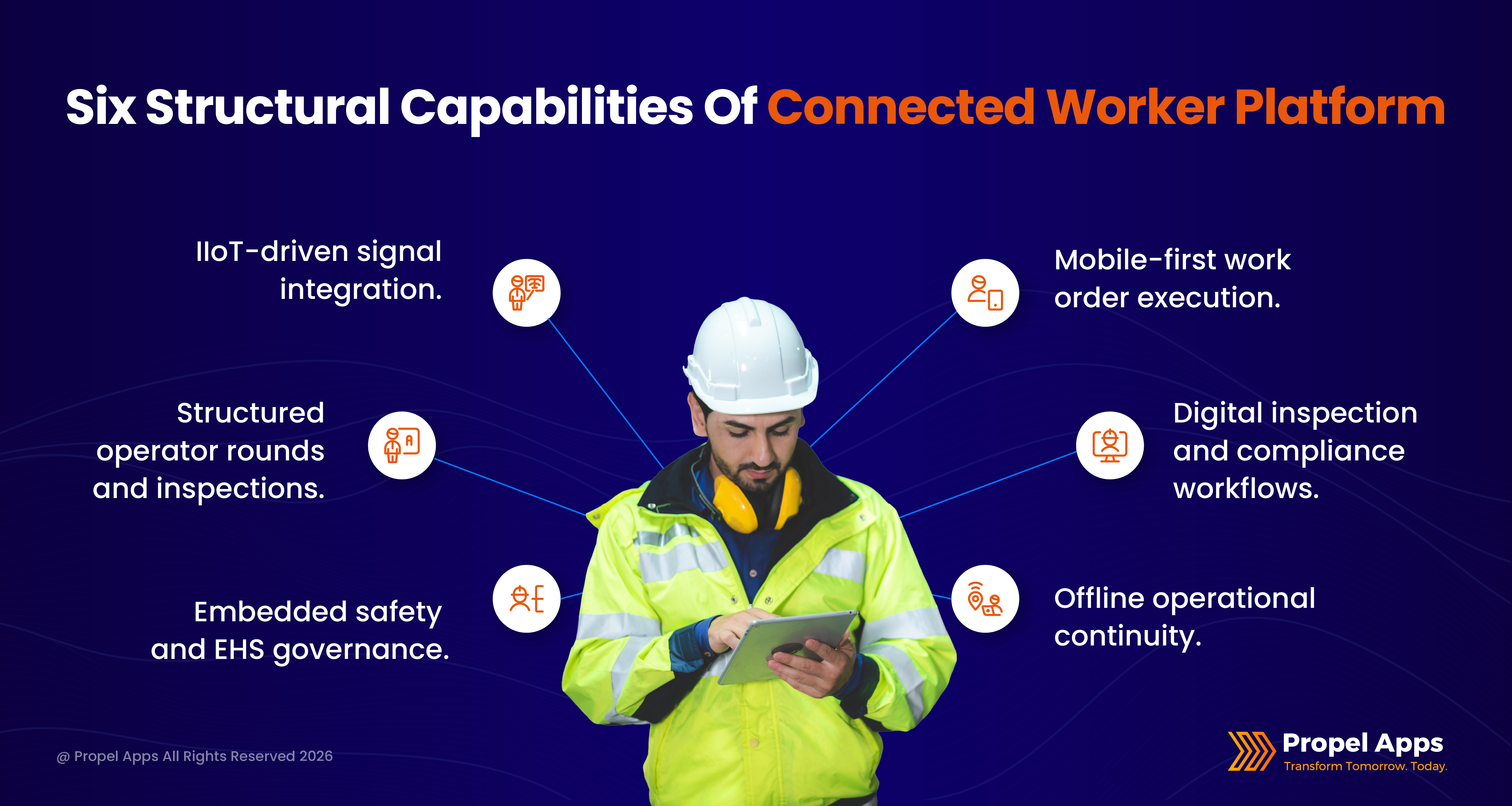
In asset-intensive industries, a connected worker platform is not simply a mobile interface.
It is an execution architecture. When integrated properly with Oracle Maintenance Cloud, it unifies six structural capabilities:
These are not isolated features. Together, they transform maintenance from reactive coordination into synchronized execution. The outcome is not digitized for its own sake. It is an operational coherence.
Traditional enterprise systems were designed for planners, not technicians.
In a connected worker model, execution begins where work happens.
In Oracle environments, mobility must not be an afterthought or a limited interface layer.
It must be execution-native - synchronized, intuitive, and frictionless. When field teams operate within the same digital ecosystem as planners and reliability engineers, visibility improves instantly.
Technician productivity rises.
Data latency drops.
Decision loops tighten.
Maintenance operations are deeply intertwined with compliance.
Permits. Checklists. Incident reporting. Risk assessments. Regulatory documentation.
When these processes remain paper-based or disconnected from work orders, organizations introduce risk at scale.
A connected worker strategy embeds digital forms directly into maintenance workflows.
Within Oracle Maintenance Cloud environments, this creates a single source of truth — not just for asset history, but for compliance with integrity.
Many asset-intensive industries operate in environments where connectivity cannot be guaranteed. If execution depends entirely on constant connectivity, productivity collapses during network disruptions.
A mature connected worker architecture supports offline-first operation.
This is not a convenient feature. It is operational resilience.
Safety cannot exist as a parallel system. In leading Oracle environments, safety is integrated directly into maintenance execution.
This approach transforms safety from compliance enforcement into operational discipline. It also enables leadership visibility into risk exposure trends across plants and regions.
Operator rounds are often the earliest line of defense against asset failure. Yet without structured digitization, observations remain informal, early warnings go undocumented, and degradation trends are missed. A connected worker strategy formalizes inspection routines.
When integrated with Oracle Maintenance Cloud, field observations strengthen predictive accuracy. Execution becomes a data engine.
Predictive maintenance initiatives frequently stall because sensor alerts do not translate into disciplined execution.
A connected worker model closes this gap.
This creates a closed-loop maintenance ecosystem — where planning, intelligence, and field action operate as one system.
The question is no longer whether to digitize the frontline. The question is whether execution systems are robust enough to support predictive, data-driven maintenance strategies. A connected worker strategy is not a technology layer added to Oracle Maintenance Cloud. It is an operating model decision. In asset-intensive industries, it is rapidly becoming the differentiator between organizations that deploy intelligent systems — and those that operationalize them consistently across every plant and every shift.