In most large maintenance organizations, prioritization appears structured on paper. There are defined priority codes, asset criticality rankings, and governance frameworks. Yet when backlog review meetings begin, a different dynamic often emerges.
Production escalations surface.
Supervisors advocate for urgent interventions.
Planners negotiate capacity constraints.
The formal priority model quietly competes with real-time operational pressure.
Over time, urgency begins to outweigh risk.
Within enterprise platforms such as Oracle Maintenance Cloud, the data required for disciplined prioritization already exists. Asset hierarchies, failure histories, compliance data, and work order records provide a structured foundation. The challenge is not data scarcity. It is decision inconsistency.
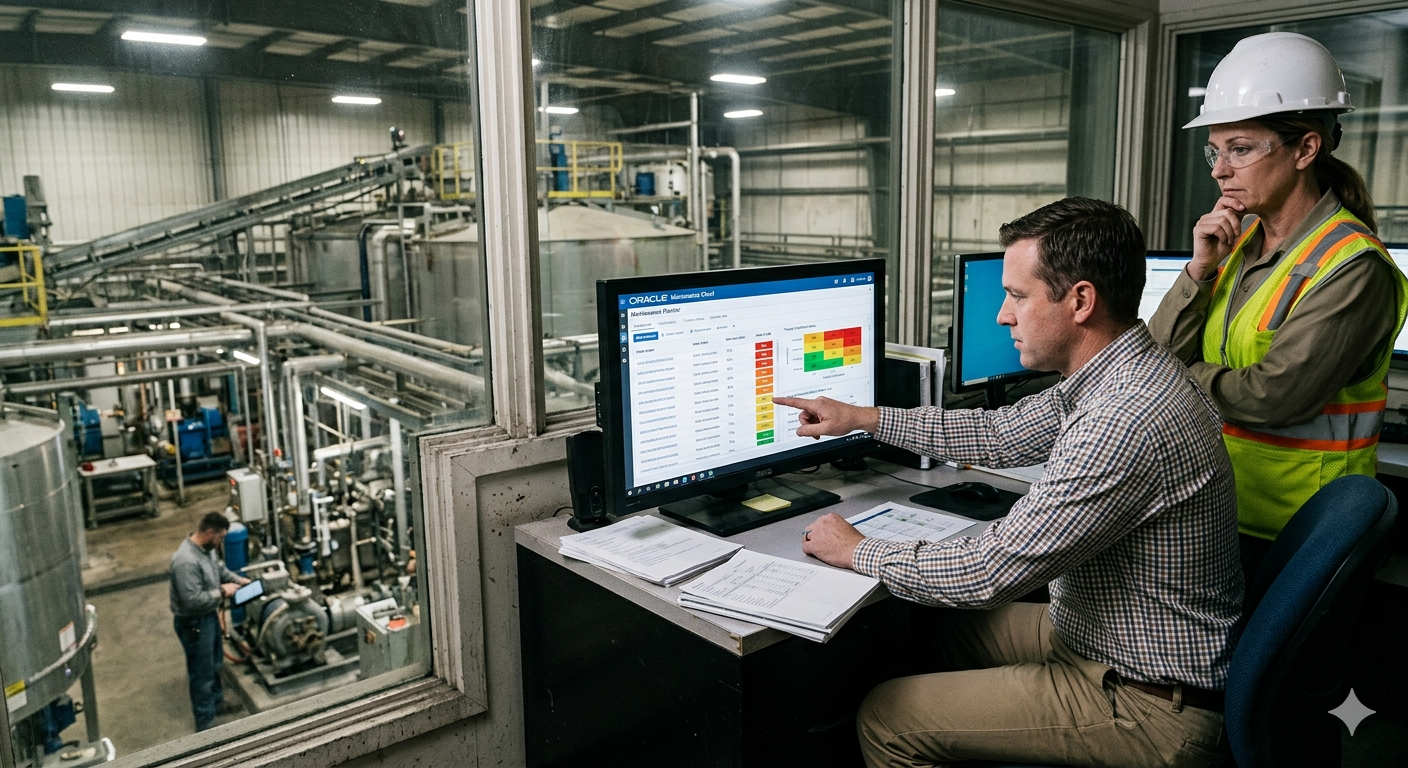
Traditional prioritization relies heavily on predefined priority levels assigned at work order creation. These codes are intended to reflect criticality and impact. In practice, they often reflect context at a single moment in time.
An issue logged during peak production may be marked “high” due to immediate operational pressure. A similar issue logged during off-peak hours may receive lower urgency. Over months, this variability accumulates. Backlogs become distorted. Lower-visibility risks remain embedded beneath louder operational concerns.
The system remains orderly. The exposure does not.
Static codes lack dynamic recalibration. They do not continuously reassess probability of failure, operational consequence, or cascading risk across asset networks.
AI-based prioritization does not remove planner judgment. It introduces probabilistic structure into it.
Rather than asking, “How urgent does this appear?” intelligent models evaluate, “What is the quantified likelihood and consequence of deferral?”
By analyzing historical degradation patterns, asset performance data, recurring failure modes, and contextual production dependency, AI scoring mechanisms surface work orders based on evolving risk exposure rather than subjective urgency.
This shift is subtle but foundational.
It moves the organization from escalation-driven sequencing to exposure-driven sequencing.
Unstable backlogs are rarely the result of insufficient labor alone. They are often symptoms of misaligned prioritization.
When risk scoring becomes dynamic, several changes typically occur. Emergency work percentages begin to decline. Preventive work deferrals reduce. Planning horizons stabilize. Conversations in weekly review meetings shift from “Why wasn’t this done?” to “What is our highest exposure this week?”
The emotional temperature of planning discussions lowers because the prioritization framework becomes defensible.
Data replaces negotiation.
Introducing AI into prioritization inevitably triggers concern among experienced planners. Many have built institutional knowledge over decades. The fear is not technological — it is professional.
Does algorithmic scoring diminish human expertise?
In mature deployments, the opposite occurs.
AI functions as a second analytical lens. Planners retain authority but gain visibility into patterns spanning years of operational history — correlations between failure timing and load conditions, between deferred maintenance and cascading incidents, between spare part delays and repeat breakdowns.
The system does not replace judgment. It broadens it.
Adoption accelerates when AI outputs are positioned as advisory signals rather than automated mandates.
Oracle-based maintenance ecosystems are uniquely positioned for this evolution because they centralize asset and work order data with governance controls. Failure codes, work definitions, and compliance records create traceable lifecycles.
When AI models operate within such structured environments, scoring accuracy improves. Context is preserved. Data lineage remains auditable. Risk-based decisions can be explained to executives and auditors alike.
This transparency matters.
AI-driven prioritization is not simply about operational efficiency. It is about defensible decision-making in complex asset networks.
Prioritization gains impact only when insights translate to execution without friction. If technicians cannot view risk context in the field, if updates are delayed due to connectivity constraints, or if inspection feedback fails to re-enter the system promptly, prioritization models lose fidelity.
This is where connected worker enablement becomes strategically relevant. Mobility, offline capability, structured digital forms, and real-time synchronization ensure that prioritization intelligence remains current.
Risk models improve only when feedback loops remain intact.
Organizations that successfully embed AI-based prioritization observe progressive, not immediate, improvement. Indicators include reduced emergency work ratios, improved schedule compliance, stabilized backlog aging, and incremental increases in mean time between failures.
The defining outcome is fewer unexpected escalations.
The planning function transitions from reactive arbitration to structured exposure management.
Work order prioritization is often treated as an administrative process. In reality, it is the control center of maintenance risk governance.
In asset-intensive industries operating within Oracle environments, complexity continues to grow — interconnected equipment, variable production demand, regulatory scrutiny, and cost pressure. Static prioritization frameworks struggle to keep pace.
AI introduces adaptive discipline into that complexity.
The objective is not automation for its own sake.
It is consistency in risk control.
When prioritization evolves from subjective urgency to probabilistic exposure management, maintenance organizations move closer to operational stability — not by working harder, but by deciding smarter.
Ready to move beyond the clipboard? Transitioning to a digital-first maintenance strategy doesn't have to be complex. We’ve helped global teams digitize their floor operations without disrupting their existing workflows. Our Connected Worker Solution is built for the field and your teams.